
St. PetersburgEaster Egg Tourbillon Clock


Grand Prix d’Horlogerie de Genève 2025
Horological Revelation Prize
The GPHG award for young brands with a fresh view of watchmaking, won by the St. Petersburg Easter Egg Tourbillon Clock.
The GPHG award for young brands with a fresh view of watchmaking, won by the St. Petersburg Easter Egg Tourbillon Clock.
Anton Suhanov brings Easter egg design back to haute horlogerie
Anton Suhanov was inspired to undertake this project by an astonishing historical parallel he discovered.
When thinking about how he could reflect the theme of St. Petersburg, the “northern capital” of Russia and the city where he had studied and practiced his profession, in his new clock, Anton came up with the idea that one of the best possibilities would be the image of an Easter egg, once transformed into a luxurious object of jewelry art thanks to the genius and creativity of the great Russian jeweler Peter Carl Gustavovich Fabergé.
Suhanov researched the history of the legendary St. Petersburg jeweler’s Easter eggs and found that his Easter egg almost always contained a surprise. It was usually a cleverly hidden piece of jewelry, a miniature painting, a portrait or a mechanical curiosity — a clockwork or even self-propelled automatons. Legend has it that even the Russian emperor who ordered the Easter gift didn’t know what a surprise it would be until he received the finished piece — that’s what it’s for! Surprise – that was the condition for the treaty by personal imperial order.

A clock with
an “Easter egg”
The idea that we can regard Carl Fabergé as the forerunner of the term “Easter egg” in the modern sense inspired Anton Suhanov to look for new possibilities for the old genre of Easter egg clock. He decided not to repeat the method of the great Russian jeweler: The surprise should not be some secret thing hidden somewhere in the Easter egg, but something different, new, unexpected, in a word, a real surprise. According to Suhanov, the real surprise should be a “secret”, i.e. a feature or function of the clock he designed that is not obvious on superficial inspection.
With the St. Petersburg Easter Egg Tourbillon clock, Anton Suhanov offers not just one, but two “secret” options. And as with the “Easter eggs” in software, films and games, the same applies here: If you don’t know the secrets in advance, the surprises only really come to light when you hold the clock in your hands and study it thoroughly.

The first secret
The first surprise, however, will probably not be a secret for those who follow Anton Suhanov’s clocks more or less closely, because it is a “flaming balance wheel”, which he has already used in the Pharos and Lotus clocks and which illuminates the three-axis tourbillon. Thanks to the luminescent inserts, the balance literally begins to glow as soon as the clock is in the dark.


The second secret
In contrast to the first secret, the second “secret” option will come as a surprise even to an expert. Anton explains his solution as follows:
A piece with a low center of gravity, when it is lower than the value of the base rounding radius, has a very interesting property — we call it a tumbler. Yes, it’s a child’s toy, a tumbler: no matter how you tilt it, it doesn’t stay down, it immediately rises back up. The story is generally puzzling, I couldn’t find anywhere who invented the tumbler.
According to Wikipedia, it was probably invented in Japan in the mid-19th century, but apparently nobody knows for sure. The principle of the tumbler appealed to me for several reasons. First, because it’s an ideal secret option: unless you gently nudge the clock and see it finally return to a vertical position after a fairly long series of swings, you’ll never guess that it works this way.
Secondly, I found it extremely encouraging: fate nudges a man, he falls, but he doesn’t give up, he keeps getting back up. Finally, a clock in the shape of a tumbler toy softens the pathos of my idea somewhat with imperial Easter gifts, an expensive tourbillon and precious decoration that is completely handmade.
— Anton Suhanov

Modern and dynamic design
Anton Suhanov was far removed from the idea of making the St. Petersburg Easter Egg Tourbillon clock in the traditional way.
Carl Fabergé’s Easter egg objects are generally an example of luxury jewelry. He did not try to be restrained in his design, which is quite appropriate for the wealth of the customer and the taste of the time. On the contrary, Suhanov strove for minimalism in his design and wanted to give the genre of Easter egg clock a different, modern, relevant vision — even breathe new life into it.
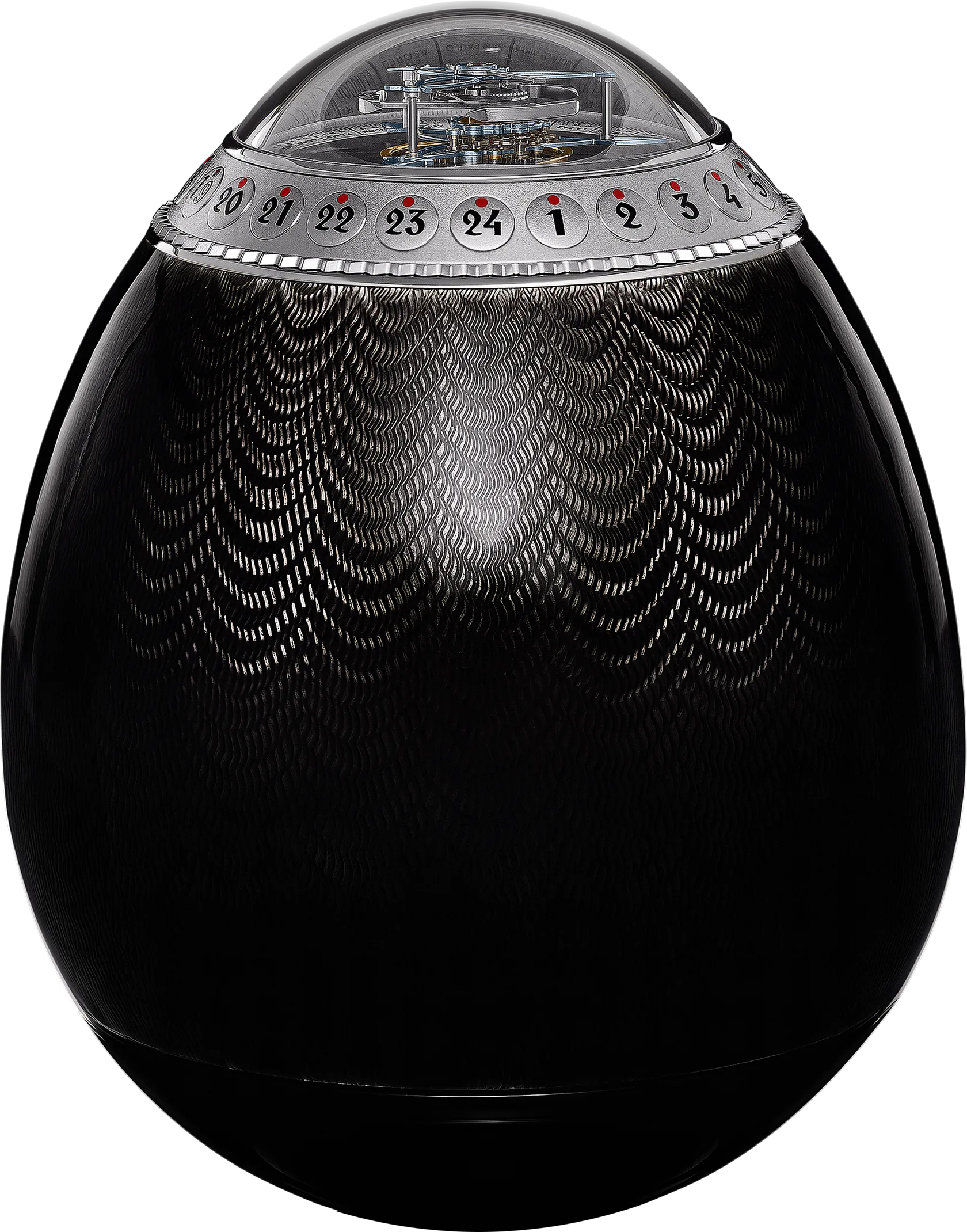
Let’s start with the fact that the St. Petersburg Easter Egg Tourbillon clock looks like the legendary egg of Columbus, which mysteriously remains in a perfectly vertical position as there are no supporting parts.
The Suhanov version of the Easter egg object is the most laconic image of a pure egg shape, which combines three main parts: a base made of mirror-polished stainless steel, the main part (“shell”) made of a hand-guilloched silver case decorated with translucent hot enamel, and finally a domed sapphire crystal placed above the tourbillon and time displays.


The only detail that stands out a little from the immaculately smooth egg-shaped figure is the bezel with the notches and markings of the 24-hour time scale; this scale also allows the seconds to be measured by the tourbillon, which makes one revolution in exactly 24 seconds. The time can be set by turning this bezel — in all 24 time zones simultaneously. The sector with the local time of Moscow (and St. Petersburg) is highlighted by a radial brushing that contrasts with the surface of the other 23 sectors of the city disk.
Guilloché and enamel


In planning the technical solutions and finishing of the St. Petersburg Easter Egg Tourbillon clock, Suhanov has created a carefully thought-out fusion of tradition and modernity, of classic watchmaking techniques and modern high-tech solutions.
The middle section of the case with the guilloché pattern and the translucent hot enamel — both are traditional for Carl Fabergé objects — looks like a dedication to the creativity of the famous Russian jeweler.
However, the centerpiece is fitted into the case in a very laconic way, without any holding parts, visible screws or decorative attachments — Suhanov had to develop a special case design to enable that type of attachment.
The guilloché engraving is executed on a specially developed guilloché machine, the construction of which is more complex than that of the classic models of the late 19th and early 20th centuries, but which at the same time has unparalleled technological flexibility and the ability to engrave a guilloché pattern on non-flat surfaces.
Tourbillon in focus
The tourbillon, a traditional complication invented 230 years ago, was designed by Suhanov in a decidedly avant-garde style with its characteristic “flaming balance wheel” and a “three-lotus-bud” cage made of titanium and dyed azure blue by anodizing.
The traditional way of displaying time with a rotating ring, which has been used in clocks since the Renaissance (this classic design can also be found in some of Carl Fabergé’s Easter egg objects equipped with a display of time), is complemented by a 24-hour world time function that has been cleverly integrated into this design.
With all these innovations, Suhanov interprets the great imperial style, which is most impressively expressed in the famous Easter egg objects, in his own way and gives it a modern character – laconic, highly technical, and dynamic.


Geneva, GPHG 2025
“Thank you to everyone who believed in and supported us. This award is an incentive to move forward and do even better.”
The Horological Revelation Prize is not awarded every year — only when there is a truly strong candidate among the contenders.
Read the news
TECHNICAL
SPECIFICATIONS

Join
waiting list
St. Petersburg Easter Egg Tourbillon Clock
Limited edition 24 pieces.